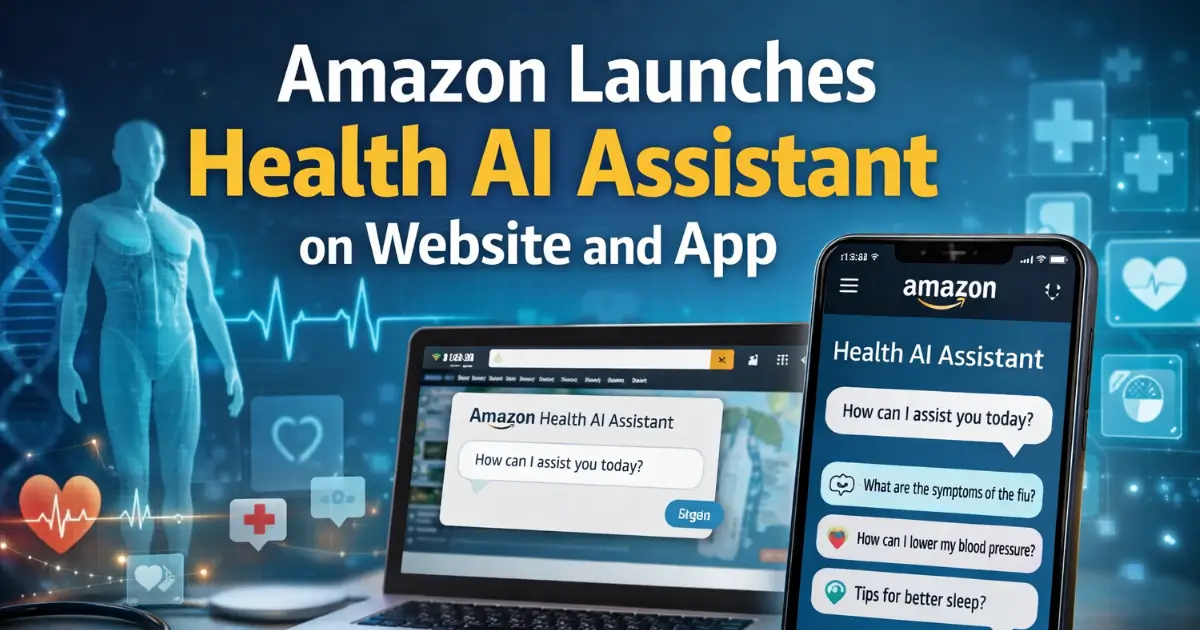
Amazon has officially expanded its healthcare AI assistant, called Health AI, beyond the One Medical app to its main website and mobile application. The move signals the retail giant’s deepening commitment to the healthcare space, two years after acquiring primary care provider One Medical for $3.9 billion.
Health AI is designed to answer health-related questions, explain medical records, manage prescription renewals, and book appointments with healthcare providers. Notably, Amazon says users do not need to be Prime subscribers or One Medical members to access the assistant, making it freely available to any Amazon user.
What Health AI Can Do
At its core, Health AI functions as a personalized health companion. While it can field general health queries without needing access to a user’s medical data, the assistant becomes far more useful when granted permission to access personal health records. Through the Health Information Exchange a nationwide secure system for sharing patient medical data Health AI can interpret lab results, review diagnoses, and provide tailored answers about symptoms and medications.
Users can ask questions like “Can you explain my recent cholesterol results?” or “I’m feeling congested and have a sore throat what should I do?” The assistant then provides personalized guidance based on the user’s medical history. If professional care is needed, Health AI can connect users directly with a One Medical provider.
Prime Perks and Pay-Per-Visit Options
Amazon is tying Health AI into its broader Prime ecosystem. Prime members in the United States who use Health AI will receive up to five free direct-message consultations with a One Medical provider. These consultations cover over 30 common conditions, ranging from cold and flu to allergies, urinary tract infections, acid reflux, and more. Non-Prime members can still connect with One Medical professionals through a pay-per-visit option.
Privacy and Data Concerns
The launch comes with significant privacy questions. Researchers have warned against sharing personal health information with AI chatbots, cautioning that companies may use conversation data for model training. Amazon has stated that it trains Health AI models on abstracted patterns rather than directly identifying information. For instance, if many patients ask about medication interactions, those patterns may be used to improve responses while keeping patient identities private.
Amazon also says that all Health AI interactions take place within a HIPAA-compliant environment, protected by encryption and access controls. However, the company has not yet disclosed the specifics of how conversations are encrypted or who exactly has access to them.
A Growing Race in Healthcare AI
Amazon’s move comes amid intensifying competition in the healthcare AI space. In January 2026, OpenAI released ChatGPT Health, a version of its chatbot specifically tailored for medical queries. Just a week later, Anthropic followed with Claude for Healthcare. Amazon’s entry brings an additional advantage: its existing healthcare infrastructure through One Medical and its massive consumer user base.
How to Get Started
Users interested in trying Health AI can sign up on the Amazon Health page. As Amazon gradually expands access, users will receive an email notification once the assistant becomes available to them. After gaining access, users simply need to create or sign in to their Amazon Health profile and start a conversation by typing a health question on Amazon.com or the Amazon app.
With this launch, Amazon is positioning itself as a serious contender in the AI-powered healthcare market. Whether Health AI can earn consumer trust around sensitive medical data and whether its HIPAA assurances hold up to scrutiny will likely determine how widely the tool is adopted in the months ahead.