
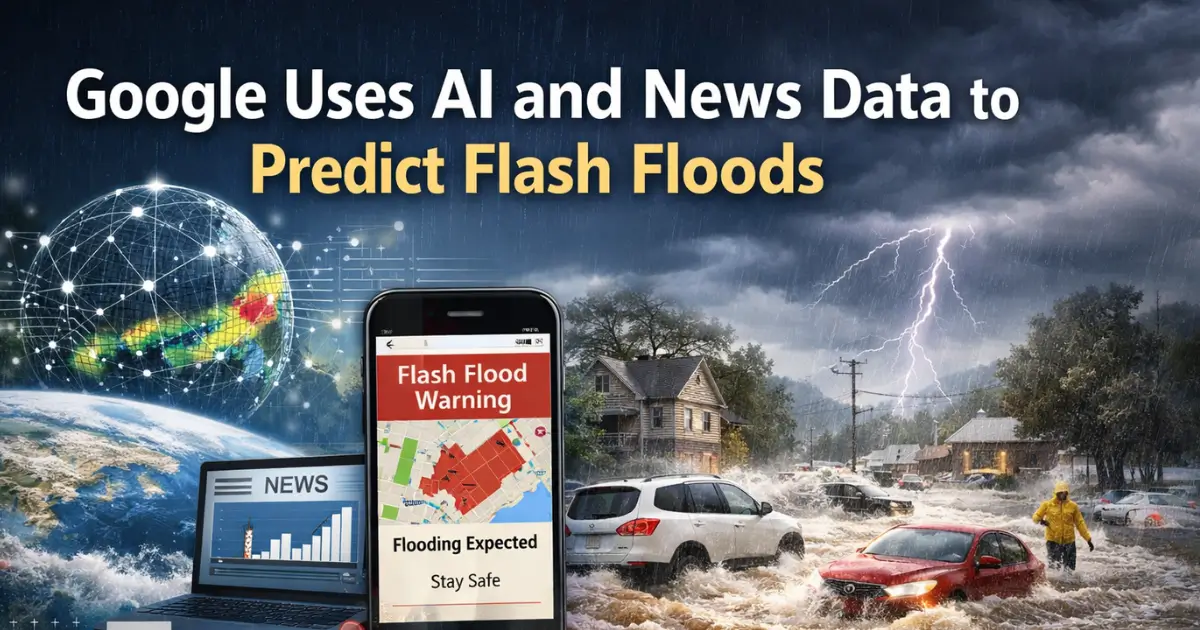
Google is turning to artificial intelligence and historical news archives to improve the prediction of flash floods, a type of disaster that often occurs suddenly and leaves little time for warning. By analyzing old news reports alongside environmental and weather data, Google aims to identify patterns that can help forecast flood risks more accurately.
Flash floods are particularly difficult to predict because they can develop rapidly in urban areas after heavy rainfall. Traditional forecasting methods often rely on river gauges and weather data, but these sources may not capture smaller or localized flood events.
Turning News Archives Into Data
To address gaps in historical flood data, Google researchers are using large language models (LLMs) to extract information from past news reports describing flooding incidents. The AI system converts these written accounts into structured datasets that can be used to train forecasting models.
This approach helps identify flood events that may not have been recorded in official monitoring systems. By transforming narrative descriptions into quantitative data, the models gain a richer understanding of where and how floods have occurred in the past.
Improving Flash Flood Predictions
Google’s AI-powered model focuses particularly on urban flash floods, which can occur quickly due to heavy rainfall overwhelming drainage systems. The forecasting system analyzes meteorological data, historical conditions, and real-time weather forecasts to estimate the likelihood of flooding in specific areas.
The model can evaluate conditions over a seven-day historical window and combine that information with forecasts for the next 24 hours. It then predicts the probability of a flash flood occurring within specific geographic regions.
Flood Hub Platform Expands Global Coverage
The technology is being integrated into Google’s Flood Hub platform, which provides flood risk information and early warnings. The platform now highlights flash-flood risks for urban areas in around 150 countries, offering valuable data to governments and emergency response organizations.
Emergency agencies have already begun using the system during trials to improve disaster response planning and deploy aid more quickly when flood risks increase.
Addressing Data Gaps in Disaster Prediction
One of the biggest challenges in flood forecasting is the lack of reliable historical data, especially in developing regions. Many flood events occur in places without monitoring infrastructure or detailed hydrological records.
By analyzing archived news coverage and combining it with weather and geographic information, Google’s AI system can reconstruct a more complete history of flood events. Researchers say this expanded dataset helps models better understand the conditions that lead to flash floods.
AI and the Future of Disaster Forecasting
The use of artificial intelligence in climate and disaster prediction is expanding rapidly. Machine learning models can analyze massive datasets from satellites, weather systems, and environmental sensors much faster than traditional simulation models.
AI-based forecasting systems are also capable of producing results within minutes rather than hours, allowing authorities to issue warnings more quickly when dangerous weather conditions emerge.
As climate change increases the frequency of extreme weather events, tools that combine historical data with advanced AI models may play a growing role in helping communities prepare for floods and other natural disasters.