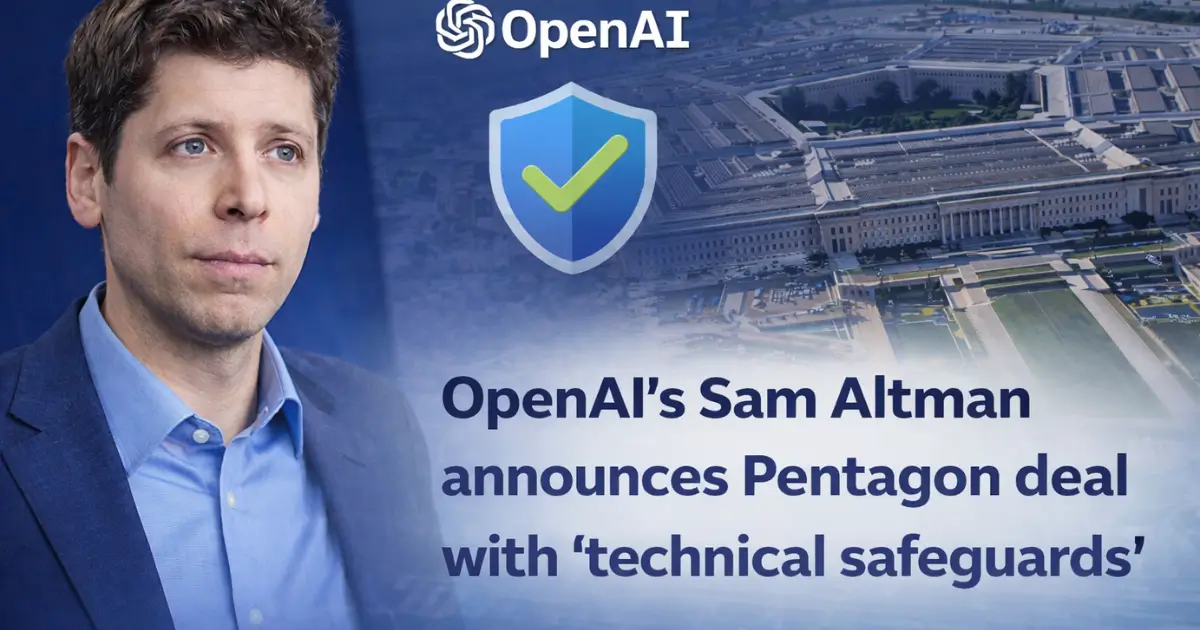
OpenAI just locked in a deal with the Pentagon. And the timing could not be more strategic.
On February 28, 2026, Sam Altman announced on X that OpenAI has reached an agreement allowing the Department of Defense now officially referred to as the Department of War under the Trump administration to deploy its AI models within classified military networks.
The announcement came just one day after OpenAI revealed that ChatGPT has crossed 900 million weekly active users and closed a record-breaking $110 billion funding round — giving the company unprecedented leverage in government negotiations.
The deal comes right after a very public clash between the Pentagon and Anthropic, OpenAI's biggest rival. It positions OpenAI as the go-to AI provider for U.S. defense operations while Anthropic faces a potential federal blacklist.
What Happened Between Anthropic and the Pentagon?
The Pentagon pushed AI companies to allow their models to be used for "all lawful purposes" within military operations. Anthropic pushed back. CEO Dario Amodei published a detailed statement saying the company never objected to specific military operations but drew a firm line on two issues mass domestic surveillance of American citizens and fully autonomous weapons systems. Anthropic's position was that in certain narrow cases, AI could undermine democratic values rather than defend them.
The response from the Trump administration was swift. President Trump publicly called Anthropic's leadership "leftwing nut jobs" and directed all federal agencies to stop using the company's products within a six-month phase-out period. Defense Secretary Pete Hegseth went further, designating Anthropic as a supply-chain risk — meaning no military contractor, supplier, or partner is allowed to do any commercial business with the company.
Anthropic responded by saying it had not received direct communication from the Pentagon and stated it would challenge the designation in court. Meanwhile, over 60 OpenAI employees and 300 Google employees signed an open letter supporting Anthropic's position.
What Does OpenAI's Pentagon Deal Include?
Here is where it gets interesting. Altman claims OpenAI's Pentagon agreement includes the exact same safety principles Anthropic was fighting for.
In a post on X, Altman stated two principles are written into the deal. First, a prohibition on using OpenAI models for domestic mass surveillance. Second, maintaining human responsibility for the use of force, including a restriction on fully autonomous weapon systems. Altman said the Department of War agreed to these principles, noting they are already reflected in existing law and policy.
How OpenAI Is Enforcing These Safeguards
The key difference from a simple policy agreement is that OpenAI is building what it calls a "technical safety stack" actual technical safeguards baked into the models to enforce boundaries during real-world deployment, not just paper promises. OpenAI will also station engineers directly within the Pentagon to oversee model behavior during classified operations.
At an internal all-hands meeting, Altman reportedly told employees that if an OpenAI model refuses a task based on its safety boundaries, the government will not force the company to override that refusal. He also publicly called on the Pentagon to offer identical terms to every AI company and expressed a desire to see the situation de-escalate toward negotiated agreements.
Why This Deal Changes the AI Industry
OpenAI managed to secure military access while apparently keeping safety boundaries intact. Whether those boundaries hold under real operational pressure is a separate question — but on paper, OpenAI now has both the deal and the safety positioning.
What This Means for Anthropic
For Anthropic, being designated a supply-chain risk does not just block direct government contracts. It prevents any military-adjacent business from working with the company. That ripple effect could damage enterprise deals well beyond the defense sector.
The Bigger Picture
The U.S. government wants AI companies inside its defense infrastructure and is willing to use economic pressure against those that resist. OpenAI chose to negotiate from inside the tent. Anthropic chose to hold its ground from outside.
Both approaches carry real risk. OpenAI's reputation depends on whether its technical safeguards actually work when it matters most. Anthropic's future depends on whether courts and public opinion can reverse a federal designation driven by political pressure.
This is no longer just a technology story. It is a test of how AI companies navigate power, principles, and national security in real time.